Showing posts with label Retrospectives. Show all posts

Friday, September 7, 2018

Ten Years Already?!

It's nearing the end of 2008, and a crazy young child eagerly turns on his television set to the Discovery Channel. He's into a strange show called The Future is Wild, which he has on DVD but is about to see on television for the first time, having seen its airing on an electronic TV guide. What he doesn't realize is that his life is about to change forever, for alongside this airing is a feature on an upcoming game called SPORE, where the player is able to evolve a creature from a tiny cartoony microbe to a spacefaring civilization. As a creative sort, he is immediately enticed by this and sets out to buy it as soon as possible. It isn't a long or hard wait, for the game comes out on September 7 and he's able to buy it on the weekend of the 13th. Once he boots it up on his computer, everything changes...

In case you couldn't tell, that's the story of how I came to play SPORE. It's hard to believe that it came out ten years today, and that I'm still playing it to an extent (mostly I just wait for anybody to come back and turn Pokemonkab's objectively mediocre creations into equally objective masterpieces). Not only that, but it's still my favorite game of all time because of how much you can do, though there are other games that have and still threaten to usurp that title (recently Rimworld, Stellaris, No Man's Sky, and The Sims 3).

Sadly, the reason that it doesn't feel like ten years since I started playing is because the game has been abandoned since 2011, when EA focused on Darkspore, which in my honest opinion is unworthy of having "Spore" in its title. Coincidentally, that's also the year I  began Spore the Next Level, with its many eye-gouge-out-inducing Artemis Fowl crossovers and the foundations of the Revolution Universe (though that wouldn't come into being until 2013).
Although EA has since discontinued updating the game, it is still supported by the amazing MaxisBazajaytee (PRAISE HIM), the servers are still online (though sometimes feel like they're being held together by duct tape and bubble gum), and plenty of talented creators are still making awesome creations that deserve their place on the MPN list. Unfortunately, the MPN Adventures list is a mess since any adventure that gets at least one play gets on there, although I have seen a few good ones here and there recently. Contrary to popular belief, the game isn't dead yet!

What Could Have Been


Thinking how long it's been since EA left Spore to wither makes me wonder what it would be like in a parallel universe where Spore was supported to the present day. By now we'd be on Spore 2 or 3, and the original game would have gotten quite a few expansion packs. The one true expansion we did get, Galactic Adventures, was simply amazing and made the game so much better, so one wonders how good future ones would have been. Presumably, we would've gotten the promised Aquatic Stage that a few people still clamor for to this very day, 13 years after Will Wright's presentation at GDC. However, the possibilities of alternate universe expansions are as endless as the game itself:

  • A Planet/Solar System editor like GA's Adventure Creator, only inside Core Spore (perhaps part of an endgame God Stage)?
  • A recent browsing of SporeWiki for ideas mentioned a cut "Terraforming Stage" that has nothing to do with the Space Stage; rather, it's in between the Civilization and Space Stage and sees your species attempting to reverse the effects of climate change, pollution, and environmental degradation you produced trying to conquer the world.
  • I've always wanted to have more exploration/depth of your solar system. Currently, it's always the same configuration (in no particular order): a yellow star with a barren world, a gas giant, a T1 world with a crashed ship, and a your homeworld with a barren moon (sometimes a strange Cube Planet). You always visit the T1 planet, scan said ship, go to a neighboring system, and leave your home system behind FOREVER. This is fine because there's not much there, but I've always wanted to have an intermediate Solar Stage where you explore neighboring planets, colonize them, and make your way to inventing FTL travel.
  • Patches to fix various annoying bugs, especially the one where the oceans disappear on planets you've terraformed (I worked hard on that!) and an outfit-replacing glitch with the Hologram Scout and GA that makes it literally unusable.
  • More exploration of planets. Although the Hologram Scout has always existed (though, as menntioned, GA makes it impossible to use) and GA let you beam down to certain adventure planets, I think it'd be cool to send away teams to any planet's surface with allied ships on "foot" or in a vehicle. You could even have extras who wear red shirts and get killed to prove how dangerous said planet is and what a terrible mistake you've made!
  • More parts packs like Creepy and Cute and the infamous Bot Parts that add interesting and wacky ways to create new creatures.
  • Something completely out of left-field that radically changes the game like GA did.
In conclusion, it's been a long ten years and so much has changed. Unfortunately, Spore hasn't been able to change ever since EA/Maxis abandoned it, and it's a shame because there's so much that could've been done to fix the game and make awesome new expansion packs. In two years, No Man's Sky went from terrible and boring to amazing thanks to post-release support; after two years, Spore was practically abandoned in favor of the inferior Darkspore... which I will always blame for "killing" Spore.
(Speaking of No Man's Sky, I'm not going to delve into the similarity between the pre-release hype and release day disappointment between the two games. At least not yet.)
In any case, let's wish a happy decennial anniversary to my favorite game, one that shaped me into who I am for better or worse.

Sunday, August 12, 2018

No Man's Sky: The NEXT Leap Forward

Le Recap

Flash back for a moment to the summer of 2016: The United States was not yet in control of an idiotic dictator, the Olympics were going on in Brazil, and I was still producing Spore the Next Level². In the midst of all these events, there was one game on everyone's minds: No Man's Sky, seemingly the most awesome space exploration game that had been and ever would be, offering quintillions of procedurally-generated worlds to explore. In the middle of August, it finally came out... only for humanity's collectively high expectations to be unfulfilled.

The general reaction to No Man's Sky when it released two years ago.
As for me, I had no interest in the game and nothing but contempt for the spam of hype it generated on the Internet, so I was somewhat glad when people didn't keep talking about it. In fact, as many of you may know, I made a joke post on this very blog that alleged the game was part of a sinister world domination conspiracy, only to realize that the game was okay upon seeing quill18 (my personal favorite Youtuber) play it. I kept thinking about getting it, but the high price ($60 USD) always turned me away since I didn't have a reliable source of income.

At release, the game was near-universally scorned for not living up to the hype of the advertising and hype it generated (which I never saw save for a Stephen Colbert segment, so I can't and don't make any judgments about said advertising), especially when it came to multiplayer and seeing other explorers in the game. Epithets like "No Man's Lie" and "No Man's Buy" became all the rage, and judging by some people's over-the-top reactions you'd think that the developers (Hello Games) murdered a hospital's worth of unborn babies. They did not, and continued developing the game, adding new features such as base building, vehicles, photo mode, better graphics and owning the colossal freighters you can find in outer space. Despite that, the game flew mostly under my radar over time and I stopped thinking about buying it completely and regarded it as a cautionary tale of hype and high expectations.

A year later (or a year ago, funny that), I rediscovered the game when Hello Games pushed out a new update, Atlas Rises, adding in (among many other things) rudimentary multiplayer where you can see people as "ghosts", reworked progression, and a subplot to the game's main story. Having heard far more positive things about it and discovering it was on sale for under $25, far more affordable than its usual price and a better reflection of its quality, I decided to finally give No Man's Sky a try. Another reason I bought it was Starbound's 1.3 update catastrophically broke several mods I was using, and No Man's Sky helped scratch the itch for space games I had. Although fun for about a month, I felt it was still rather lacking in some areas, a bit boring and repetitive, and was burdened by its failed hype campaign a year previously. Once I figured out how to fix Starbound, I went back to playing that that and left No Man's Sky behind for good... or so I thought...

Another Year, Another Update

Following a pattern of attracting my attention with new updates and then disappearing under my radar, No Man's Sky came back into my life two weeks ago with the update simply titled NEXT, an update that finally added the promised multiplayer, the ability to see your character and interact with others, and an overhaul of crafting and progression. In complete contrast to the release version, NEXT has drawn a significant influx of positive reviews, with some praising it as a "redemption story" and leading one fan to create a colossal monument of lead developer Sean Murray that's visible from space in the same way the Great Wall of China isn't.

The two features from the patch notes that finally drew me in were a rework to base building that allows you to have multiple bases across planets and systems like Starbound (previously, you could only have one base on a single planet) and planetary rings that make planets stand out and look sci-fi-y (yes, that's a thing now). I went in and found the game to be indeed much better than what I'd played a year previously, and since then I've been having tons of fun. The game feels more organic and complete in a way that's hard to describe; perhaps because interlinked systems come together and just work.

Is the game perfect? No, there are some performance issues, graphical bugs I've noticed, and I don't think it's worth the $60. However, as mentioned before, I do think it has substantially improved in many ways. I'll list some of the highlights I've found the best alongside cool photos I've taken:
  • Space combat feels far easier than in Atlas Rises, where I kept getting hammered by space pirates and needed to be a pacifist. Now, flying your ship feels smoother and the pirates are much less threatening. I've actually grown to like space combat a lot to the point where I'll be a space mercenary and accept contracts to blow the suckers into the sky.
  • A feature added in Atlas Rises was the ability to own multiple starships when you managed to get the millions of units (the game's currency) needed to buy off a freighter captain. Now you have access to this immediately for free, allowing you to purchase a wide range of ships. Specializing them for combat, hauling, or exploring is encouraged.
    • Speaking of freighters, owning them is now as easy as answering a distress call and fighting off a pirate raid on one of them. Granted, you'll have to fight waves of enemy ships to get it for free, but as I mentioned space combat is now easier and more fun, so this wasn't a problem for me.
    • Alongside freighters are support frigates, large ships you can send off to the corners of the galaxy on specialized expeditions. My freighter started with a trade vessel (upper middle of the photo to the right) that I've successfully sent off on two lucrative trade missions that progressed over an hour of real time and gave me untold thousands of units. Additionally, you can recruit more frigates of various specializations via cash like with new ships, though they can be quite pricey. It makes you feel more like a ship commander and can be a good way to earn money and/or kill time on your adventures.
  • Resources have been reworked, and you'll need to refine and craft a lot more to get valuable items such as thruster fuel for take off, "chromatic metal" that has several uses, and pure ferrite for base building. Although it's harder to get what you need, the old system always felt a bit too easy, plus it makes things a bit more interesting.
  • You've always been able to find free crashed ships at the price of your old one and whatever it
    had in it, but since Atlas Rises (I think) you need to repair their inventory slots with your hard-earned units. Now you'll need tons of resources to fix said slots and make your ship fully-armed and operational, making you feel like a car hobbyist repairing an antique automobile. I'm still in the process of repairing my Pride of Sutikh hauler ship, which still requires a lot of magnetized ferrite, chromatic metal, and tech modules to restore it to its old glory.
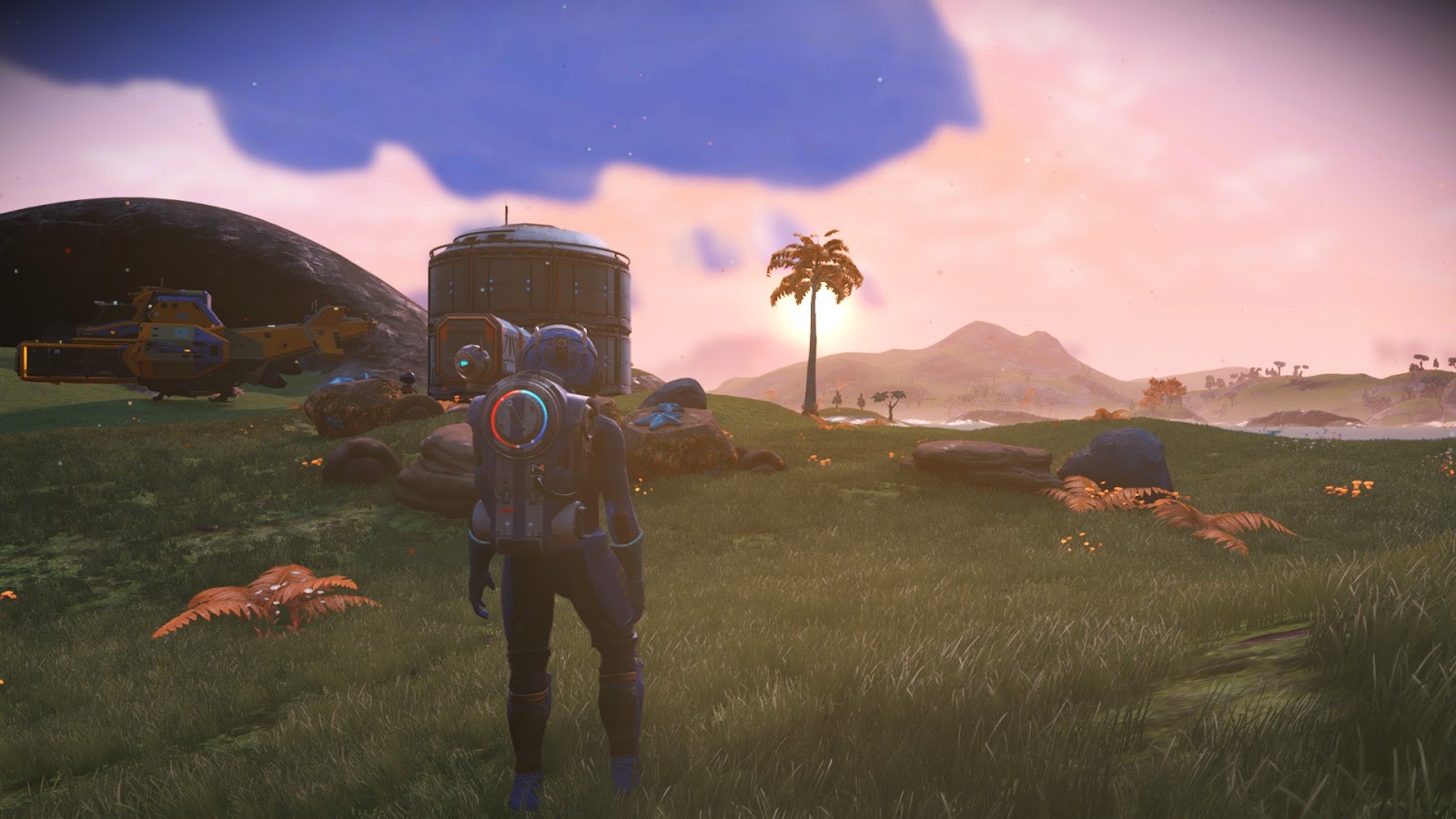
  • The best part about the NEXT update is the reworked graphics. In the release version, everything had an ugly pea soup hue to it which I never liked and made things uninteresting. Now the game feels a lot more vibrant, colorful, and attractive, helped by the addition of full volumetric clouds and even rings to the skies of planets.
  • As I mentioned earlier, there is now a fully-integrated multiplayer where you can meet others, team up with them, or even be a big jerk. I'm not a big fan of multiplayer personally, but I do like the idea of it, especially since it prompted the addition of...
  • Character customization! Prior to NEXT, you lacked a character model and thus there was no ability to know who or what you were (although I always assumed the player was a human). You start off as an astronaut in an orange suit, but via a space station module you can become a burly Vy'keen warrior, a small Gek trader, a robotic Korvax, or a strange Traveler*. I stuck with the "Anomaly" astronaut look, but donned a cool helmet (complete with gold visor to protect against solar exposure) and a slick blue suit.
    • *It should be noted that the game's developers are British and spell it as "Traveller". However, for this blog, I prefer to use American spellings since that's what I'm most familiar with and what my spellchecker prefers. 
  • Planets still aren't as varied as they could be when it comes to flora and fauna, but nevertheless come in enough interesting combinations of colors, water levels, and KILLER DEATH SENTINELS to look different. I've come to accept that the problem of low variety is a with the concept of procedural generation in general and not No Man's Sky. It's not so bad with artificial constructs like buildings and ships, but with creatures it's an issue since scanning and naming them is a big part of progression, albeit less so in NEXT since money is not as big of a reward as it was unless you get scanner upgrades.
  • As mentioned before, bases can now be built on any planet provided you have the resources to build a base computer to claim the area. In Atlas Rises, you could only build a single base in a flat predetermined area on one planet. Now, a base computer allows you to set up shop anywhere in a vast array of landscapes, such as on an island on a verdant planet like I did. I can't stress enough how appealing this is to someone as creative as myself, to the point I'm thinking about starting a game on Creative Mode just to check out cool planets and build equally cool bases on them.

In Summation

Despite being buggy, boring, not much to look at, and lacking at release, No Man's Sky has benefited from continued support over the last two years and has become an excellent (albeit still imperfect) space game that is currently one of my most-played on Steam. A special thanks must go to Hello Games for persevering and supporting the game despite the vitriolic criticisms at release, rather than simply shrugging and deciding "that's it, we made a game that sucks, let's try something else". The graphics, crafting, base building, and multiplayer are now far better than anything before in this game, and I can confidently say that NEXT is a tremendous improvement that makes the game what it should've been two years ago. (Although, have they ever heard of beta/early access?)

Monday, May 8, 2017

Stellaris: One Year Later

Hard to believe that it's been almost one whole year since Paradox Interactive released Stellaris on May 9th, though I'd been getting myself hyped by reading the dev diaries, watching Quill18's space cats, and watching the friendly exploits of the Blorg Commonality on the official Extraterrestrial Thursday streams for months before the game hit. Since Stellaris has been one of my favorite games since then (alongside Starbound and Spore... interesting how they all start with "S"), I figured I'd look back at some of the major changes Paradox has made to the base game since 1.0 with the five (soon to be six) major patches and two expansions, and my personal opinions on them.
(Also, for more information than I could ever explain, you might want to check out the official Stellaris wiki.)

Excellent Changes (or OH MY GOD WHY WASN'T THIS IN THE BASE GAME)


  • Borders (1.2/Asimov): It used to be that the game came to a screeching halt when your borders ran up against a rival empire and trapped you in your own territory. Their borders were always closed, unless you were in an alliance or somehow managed to bribe them, and you couldn't explore star systems or complete special project chains (such as collecting animals or surveying dead planets to hopefully avert a mass extinction) or go and kill those fanatical purifiers on the other side. Then along came the 1.2 update, which dramatically improved how borders function. Now, all borders are open by default but can be closed as part of or to instigate a rivalry. I can't tell you how much this improves the game; it means you can complete project chains in much quicker time and gives your science ships much more to do.
  • Habitability (1.3/Heinlein): One of the more interesting concepts is the game is colonizing planets: you can only colonize certain planets depending on the biome of your homeworld-for example, humans prefer continental Earth-like planets but can do okay on ocean or jungle planets; and my Lyrites prefer rocky arid planets but can somewhat tolerate sandy deserts. However, before 1.3, the planets were arranged into a wheel pattern that caused some issues: people on arid planets could live on cold tundra planets with no problem, and jungle-dwellers could live in sandy deserts. I actually exploited this once when I uplifted some strong-but-dumb Zukakkans who lived on the arid planet Baidaan III and used some Kenjodans (a race of mammalians whose empire got partitioned into a war; I took two planets and allowed two others to form another empire based on my principles in something resembling a space East/West Germany). To make things even more frustrating, you only gained the ability to colonize planets based on technology, so I had to wait decades until the Kenjodans I conquered could settle new tundra planets and expand my dominion. Of course, this made no sense whatsoever, and finally in 1.3 it was solved when habitability was reworked: now planets are arranged into a grid based on climate, so desert-dwellers specifically prefer dry planets, ice-lovers like cold planets, and humans still like ocean/tropical planets. The technology requirements for colonization were also removed (and the latest patch allows you to start able to colonize... more on that later), so you can colonize every type of planet from the get-go.
  • Integrating Aliens (1.5/Banks): As I mentioned, expansion to different types of planets is accomplished through either: 
    • Sufficiently advanced robots
    • Genetically modifying your people
    • Using aliens who've come to your planets, peacefully or not
    The latter option is the easiest, most interesting, and most readily available, but it comes at a cost since the aliens may not have the same ideologies and/or be cranky about you conquering their planets for some reason. However, perhaps you're benevolent and want to do more with your new citizens for colonizing; perhaps you want to allow them full rights and even allow them to produce leaders to aid your empire? It was possible in Stellaris, but as with colonization it was only possible via a technology that was really annoying to get. In the latest patch, 1.5, this has been changed so that you can not only have alien leaders from the start but also specially tune the rights each race in your empire has. For example, perhaps there's some lizard people who live long and gain experience quickly (making them amazing leaders), whereas a bunch of bird-people have short lifespans. In this case, you'd allow the lizards to produce leaders but bar the birds.
    In my current game, I conquered a race of spiritualist lizards called the Netraxi, and soon had one of my top-level human scientists die peacefully of old age. I looked in the replacement panel and sure enough, there already was a Netraxi there waiting to get recruited. I of course said yes, and he might just become ruler of my empire, which is interesting to consider (especially since I'm not a xenophobe)
  • Factions (1.5/Banks): Another recent change; before 1.5, factions in your empire would form and always be rebel scum that had to be suppressed and/or purged. Thankfully, this was changed so that factions represented political movements/parties that represented specific issues tied to the different ethics in your empire; for example, xenophobes hate aliens having equal rights and like having your primary species as ruler, whereas materialists love having robots but don't like it when you fall behind in technology. It makes things more interesting and actually makes factions helpful rather than an annoyance; it now becomes possible to embrace their ideology and change your ethics entirely!
  • The Midgame (1.5/Banks): One of Stellaris' weaknesses is the midgame, where exploration slows and you start to interact with (i.e. conquer) the empires around you. Eventually, you realize that very little is happening and you decide to just abandon your current campaign and see what else there is to offer (well, I do anyways). Thankfully, this has been something Paradox has noticed and is attempting to improve, but I feel they really struck gold with the most recent (as of writing) patch and accompanying expansion Utopia. Now you can choose an endgame goal for your empire, such as uploading your people into robots or becoming psionic, and this gives you a better goal to work with and keep you waiting through the midgame. There's also the option to build megastructures such as ringworlds or Dyson spheres et al., giving you even more incentive to stick around for a bit and keep playing through the midgame slog-fest.

    Good Changes (I haven't seen these personally, or perhaps they just aren't as good as the above)


  • Slaves (1.2/Asimov): No decent sci-fi would be complete without slaving jerks, and thankfully this has been a key part of playing as collectivists/xenophobes from the very beginning. However, at first it was possible to game the system by enslaving people so that they didn't have happiness and thus join annoying rebel factions. In 1.2, this was changed so that slaves went into one of two factions: Docile slaves who only wanted regulation, and Malcontents who wanted freedom at any cost. With 1.5, this was changed further with an Unrest mechanic that makes slaves highly dangerous and rebellious if not controlled with armies.
  • Fallen empires (1.3/Heinlein): Far more interesting than normal empires, fallen empires are ancient beings with advanced technology who once controlled much of the galaxy, though are isolationist and have a relatively small amount of territory (somewhat like the Siranians from Spore Revolution). However, they were relatively uninteresting and not varied enough before 1.3 came out, which made it so that they could awaken depending on galactic events and some of them will even ask the younger races for help. Under the right circumstances (i.e. an accompanying DLC), two awakened Empires can even start a massive War in Heaven that will involve all the younger races of the galaxy and massively reshape the map.


  • Infiltration (1.5/Banks): Those of you who have read my Lyrite playthrough will know that it is possible to infiltrate industrial-age aliens in an attempt to gain control of their precious planet (like lizard-people are certainly not doing to our own Earth) by disguising your people to resemble the natives. Though pretty explicitly mentioned as due to genetic manipulation, I preferred to explain early-game infiltration (i.e. before you discover genetic engineering tech) as holographic disguises, until Banks came along last month. Now infiltration explicitly requires said technology, which makes it more of a midgame option. That's okay, because now it makes more sense and invading the poor fools is still a perfectly valid option.
  • Space Monsters (1.3/Heinlein): Another classic sci-fi theme present in Stellaris is spaceborne creatures, like the various noncorporeal beings or the Crystalline Entity from Star Trek. From 1.0 onwards, the monsters were spread like butter over regions of the galaxy with no context of how they got there or where they came from (especially since I doubt many of them had "natural" FTL travel). In 1.3 however, space monsters were changed so that they inhabited a particular region of space, with a home system containing a powerful base and special rewards. I quite like this change as it makes finding space monsters less irregular, though it is somewhat obnoxious to see mining drones over and over again like in my current campaign.

Neutral Changes (not good, but not horrible either)

  • Hyperdrive (1.3/Heinlein): In Stellaris, you have three options for faster-than-light travel (FTL): warp drive that allows you to travel slowly to any star system (based on the Alcubierre Drive and Star Trek's warp drive); hyperdrive that allows you to travel very fast along predetermined and strategic routes (my personal favorite); and wormholes that require special stations to send ships to any star instantly. Since release, the particular numbers behind the methods have been heavily balanced, but a drastic change was made in Heinlein when hyperdrive charging was increased and required ships to move to the outer edge of a star's gravity well to go to FTL (previously hyperdrive ships could jump to hyperspace anywhere in a system). While it slows down hyperdrive considerably, that particular method of FTL was pretty overpowered anyways.

Bad Changes (why Paradox why)

  • Warp Drive (since 1.0): As I mentioned earlier, warp drives are slow; need to charge up and cool down when leaving and entering a solar system, respectively; but have the advantage of unlimited movement between star systems. Since release, however, that advantage has become somewhat moot with continuous nerfs to warp drive, whether it's slowing it down even further or increasing the chargeup/cooldown times. Warp drive is now almost unbearably slow and is not a good pick, which is a problem because I feel that there should be at least some incentive to choosing one FTL type over another, even if it is just to shake things up. However, I have heard that future plans for the game include making hyperdrive the starting option and having warp/wormholes be research options, so that may be the incentive for this.
  • Uplifting (1.4/Kennedy): Oddly enough, this particular issue is going to be fixed in the upcoming 1.6/Adams patch on the 1-year anniversary, but until then this poor design decision is still valid and annoying. Anyways, remember how I mentioned the Zukakkans, the lizard people I uplifted from a pre-sentient state? This is a perfectly viable midgame option for empires wishing to gain  one or more of the following: access to new planet types for colonization, a new species, a working class of dumb laborers, or even the fabled cockroaches who can live anywhere (especially nuked planets). While it used to be perfectly fine to simply have their planet in your borders (I got access to Baidaan III by colonizing a nearby Earthlike planet the settlers named Albion), in 1.4 this was foolishly changed so that you had to colonize the planet itself to uplift them. Not only did this "break immersion" since researching/conquering planets has no habitability or colonizing requirements, it also made uplifting less of an incentive and reduced it to merely a prerequisite for actual genetic engineering. Sure, using robots is an option, but it's tedious to micromanage building them manually and there's always the chance they can rebel if your research makes them too smart. Furthermore, roughly 90% of uplifting happens because you want a species to be able to handle new planetary climates to expand your empire. At least this is going to be fixed very soon, but I'm still somewhat annoyed the colonization route was even considered to be a better option than simply allowing you to uplift when the planet's in your borders. Remember, game devs: if it ain't broke, don't fix it!

Conclusion

As mentioned before, these are only the biggest changes I felt affected me and were worth talking about. There are plenty of other tweaks that have been made over the years, like changing space battles so they aren't horrible swarming messes, minor weapons balances you'll only notice in a mouse-over tooltip, or the new set of beautiful skyboxes that replaced the bland default one. I feel that the game has improved significantly since release, especially with the new Banks update back in April (as you can tell by the changes I listed). Will the game be even more awesome on May 9th, 2018? Only time will tell...

Here's another one of my favorite Banks changes: ship/station colors
based on your flag! This in particular is a Netraxi construction ship,
since they had a purple and green flag.